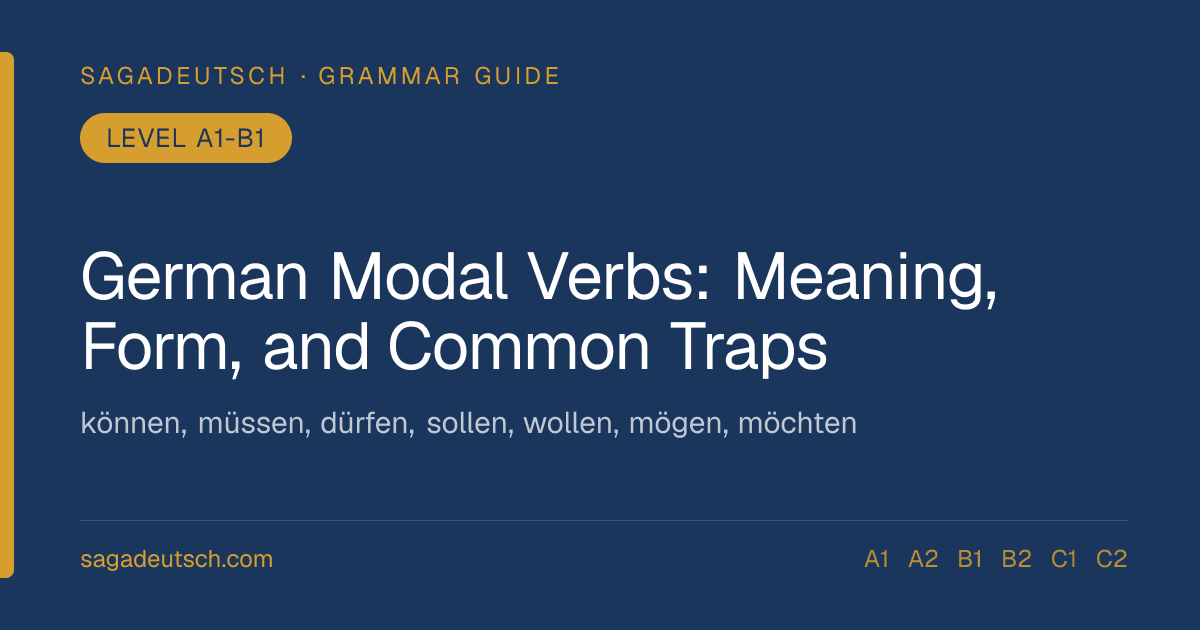
German modal verbs explained: what können, müssen, dürfen, sollen, wollen, mögen and möchten mean, how to conjugate them, and the traps exams love.
German modal verbs decide the tone of almost every sentence you say: whether you must do something, may do it, want to do it, or would politely like to. There are six of them, plus one polite form that behaves like a seventh, and they break the normal conjugation rules. If you write ich kanne or translate nicht müssen as "must not", a Goethe or telc grader spots it in seconds. This guide covers what each modal verb means, how to conjugate it, where it goes in the sentence, and the negation trap that catches learners from A1 to B1.
What the six German modal verbs mean
The German modal verbs are können, müssen, dürfen, sollen, wollen and mögen. Each one changes the meaning of the main verb rather than describing an action of its own.
- können = can, be able to. Ich kann gut schwimmen. (I can swim well.)
- müssen = must, have to. Ich muss heute lange arbeiten. (I have to work late today.)
- dürfen = may, be allowed to. Hier darf man nicht rauchen. (Smoking is not allowed here.)
- sollen = should, be supposed to. Der Arzt sagt, ich soll mehr schlafen. (The doctor says I should sleep more.)
- wollen = want to. Sie will in Deutschland studieren. (She wants to study in Germany.)
- mögen = like. Ich mag deutsches Brot. (I like German bread.)
Then there is möchten, which means "would like". Grammatically it is the Konjunktiv II of mögen, but you should learn it as a seventh modal verb with its own forms, because you will use it constantly. Ich möchte einen Termin vereinbaren. (I would like to make an appointment.)
Three pairs cause most of the confusion, so pin them down early:
- müssen vs sollen: müssen is a necessity you accept as real (Ich muss den Zug um 7 nehmen). sollen reports someone else's expectation or advice, and leaves open whether you follow it (Ich soll den Zug um 7 nehmen - someone told me to).
- dürfen vs können: dürfen is permission, können is ability. Darf ich hier parken? asks whether it is allowed; Kann ich hier parken? asks whether it is possible. Casual speech blurs the two, but exams reward the precise choice: rules and prohibitions take dürfen.
- wollen vs möchten: both express desire, but wollen is blunt and möchten is polite. In a café, Ich möchte einen Kaffee is normal; Ich will einen Kaffee sounds like a demand. Use wollen for plans (Ich will nächstes Jahr die B1-Prüfung machen), möchten for requests.
Present-tense conjugation: the forms exams test
Modal verbs conjugate irregularly in the singular: the vowel changes, and ich and er/sie/es take no ending at all. It is ich kann, never ich kanne, and er muss, never er musst. The plural forms are regular and look like the infinitive.
| können | müssen | dürfen | wollen | sollen | mögen | möchten | |
|---|---|---|---|---|---|---|---|
| ich | kann | muss | darf | will | soll | mag | möchte |
| du | kannst | musst | darfst | willst | sollst | magst | möchtest |
| er/sie/es | kann | muss | darf | will | soll | mag | möchte |
| wir/sie/Sie | können | müssen | dürfen | wollen | sollen | mögen | möchten |
Notice the pattern: ich and er/sie/es are always identical. sollen and möchten keep their vowel; the other five change it in the singular. Drill the ich and er forms hardest, because that is where learners invent endings that do not exist.
Modal verb word order: position 2 plus infinitive at the end
The modal verb takes position 2 in a main clause, and the main verb goes to the very end as an infinitive. German grammar calls this the verb bracket (Satzklammer), and everything else in the sentence sits between the two verbs.
- Ich muss morgen früh zum Arzt gehen. (I have to go to the doctor early tomorrow.)
- Wir können am Wochenende zusammen für die Prüfung lernen. (We can study together for the exam at the weekend.)
The infinitive never carries zu after a modal: it is Ich muss arbeiten, not Ich muss zu arbeiten. This trips up English speakers because of "have to".
In a subordinate clause the rule changes: both verbs move to the end, and the conjugated modal comes last.
- Ich komme nicht mit, weil ich heute arbeiten muss. (I am not coming because I have to work today.)
- Sie fragt, ob sie das Fenster öffnen darf. (She asks whether she may open the window.)
This infinitive-plus-modal ending appears in nearly every B1 writing task. If subordinate word order still feels shaky, the guide to German connectors from B1 to B2 covers which conjunctions kick the verb to the end.
One more useful rule: when the context makes the action obvious, German drops the infinitive entirely. Ich kann Deutsch (I can speak German), Ich möchte einen Kaffee (I would like a coffee), Er muss nach Hause (he has to go home). These are complete, correct sentences.
The negation trap: nicht müssen does not mean "must not"
Nicht müssen means "do not have to". Nicht dürfen means "must not". This is the single most reliable modal-verb trap in reading and grammar sections, because English "must not" pulls you toward the wrong verb.
- Du musst nicht kommen. = You do not have to come. Coming is optional.
- Du darfst nicht kommen. = You must not come. Coming is forbidden.
Read Sie müssen das Formular nicht ausfüllen in an exam text and the correct understanding is "you are not required to fill in the form", not "you are forbidden to". Get this backwards in a Lesen task and you pick the exact wrong answer the test writers planted for you.
The other negations behave as expected: nicht können = cannot, nicht wollen = do not want to. Only the müssen/dürfen pair swaps meaning under negation, so give it its own flashcard.
Modal verbs in the past tense: use the Präteritum
For modal verbs, the Präteritum is the standard past tense even in everyday speech. Germans say ich musste gestern arbeiten, not ich habe gestern arbeiten müssen, even though the second form exists. This is the big exception to the rule that spoken German prefers the Perfekt.
| können | müssen | dürfen | wollen | sollen | mögen | |
|---|---|---|---|---|---|---|
| ich / er / sie / es | konnte | musste | durfte | wollte | sollte | mochte |
| du | konntest | musstest | durftest | wolltest | solltest | mochtest |
| wir / sie / Sie | konnten | mussten | durften | wollten | sollten | mochten |
Two things to memorise from this table. First, the umlaut disappears in the Präteritum: können becomes konnte, müssen becomes musste, dürfen becomes durfte, mögen becomes mochte. Write ich müsste when you mean ich musste and you have accidentally produced a Konjunktiv ("I would have to"), which changes the meaning. Second, möchten has no past tense of its own; for "wanted" in the past, use wollte: Ich wollte gestern anrufen.
The double-infinitive Perfekt (Ich habe kommen müssen) is real German, but at A2 and B1 you gain nothing from it. Examiners expect the Präteritum for modals, and it is shorter and harder to get wrong. Where each tense belongs is mapped out in the overview of German verb tenses by level.
Common traps to check in your own writing
Most modal-verb mistakes fall into a short list, so proofread your writing against it.
- Invented endings: ich kanne, er musst, sie wills. The ich and er/sie/es forms have no ending. Full stop.
- Infinitive not at the end: Ich muss gehen heute zum Arzt instead of Ich muss heute zum Arzt gehen. The bracket must close at the end of the clause.
- zu after a modal: Ich möchte zu lernen. Modals take a bare infinitive, no zu.
- musst nicht for prohibition: if something is forbidden, you need darfst nicht.
- will as future tense: German will means "wants to", never English "will". Er will kommen = he wants to come, not he will come.
- möchten in the past: there is no ich möchtete. Switch to wollte.
- Umlaut kept in the Präteritum: ich könnte (I could, hypothetically) is not ich konnte (I was able to). One dot pair changes the tense and the meaning.
Honest warning: knowing this list is not the same as producing the forms under time pressure. The singular vowel changes only become automatic through repetition. The Grammar Practice exercises on SagaDeutsch drill modal conjugation and word order in exam-style gap sentences, which is a faster feedback loop than rereading tables.
How exams test modal verbs
Graders check modals in your writing, and reading tasks exploit the nicht müssen / nicht dürfen contrast in true-false items. At A1 and A2 you mainly need clean present-tense forms and möchten for polite requests. At B1 the Präteritum forms and subordinate-clause word order (weil ich arbeiten musste) become essential, especially in letter writing. Signs and notices in reading sections lean heavily on dürfen: Hier dürfen Kinder nicht spielen is prohibition. If B1 is your target, the Goethe B1 exam guide shows where grammar accuracy earns points across the four sections.
Frequently asked questions
The six German modal verbs are können (can), müssen (must), dürfen (may), sollen (should), wollen (want to) and mögen (like). Most courses add möchten (would like) as a seventh, since it conjugates like a modal and appears constantly in polite requests. All of them push the main verb to the end of the clause as a bare infinitive.
dürfen expresses permission, können expresses ability. Darf ich gehen? asks if you are allowed to leave; Kann ich gehen? asks if you are able to. Spoken German often uses können loosely for permission, but rules, signs and prohibitions always take dürfen, and exam answers expect that distinction, especially in the negative: darfst nicht means it is forbidden.
No. nicht müssen means "do not have to", so the action is simply optional: Du musst nicht bezahlen = you do not have to pay. English "must not" translates as nicht dürfen: Du darfst nicht bezahlen would mean paying is forbidden. This reversal is a deliberate trap in reading comprehension tasks, so double-check every negated müssen you meet.
möchten conjugates: ich möchte, du möchtest, er/sie/es möchte, wir möchten, ihr möchtet, sie/Sie möchten. The ich and er forms are identical and end in -e. It is technically the Konjunktiv II of mögen, which is why it has no past tense of its own; to say "wanted" in the past, switch to wollte.